Project Inspiration · 26 November 2026
What Makes a Premium Furniture Supplier Reliable Across Long Projects?
What makes a premium furniture supplier reliable across long projects? A practical framework for firms evaluating consistency and documentation.
The right premium furniture supplier for long projects is one that can prove, in writing and in samples, that a piece ordered in month one will still match a piece ordered in month twenty: same finish, same tone, same hand. For architecture firms running hospitality, corporate or residential developments over eighteen months or longer, this matters more than any single hero piece in a catalogue. The rest of this article breaks down what to actually look for, and why it is harder to find than it sounds.
Why Long Projects Expose the Weaknesses of a Furniture Supplier
A short residential project can survive an inconsistent supplier. A hotel refurbishment or a corporate headquarters spread across multiple phases cannot. When a project runs for one, two or three years, the furniture supplier is exposed to changes in team, in raw material batches, in production capacity and in the client's own evolving brief. Any weakness in the supplier's internal process eventually surfaces, usually at the worst moment: mid-installation, with a second phase already ordered.
The most common failure is not a single bad delivery. It is drift: the first batch of a sofa or a cabinet is excellent, and the third batch, ordered fourteen months later, is noticeably different in finish, tone or proportion. For an architecture firm presenting a unified space to a demanding client, this is a real risk, and it rarely shows up in a showroom visit or a first sample.
The Criteria That Actually Predict Reliability
Firms evaluating a supplier for a multi-phase project tend to focus on price and lead time first. Both matter, but neither predicts whether the supplier will still deliver consistent work in phase three. A more useful set of criteria looks at the structure behind the production, not just the first sample on the table.
- Documented specifications: technical sheets and materials references that do not depend on one person's memory of how a piece was made the first time.
- A traceable materials and finishes system, so that a wood tone or a leather specified in month one can be matched in month twenty without guesswork.
- Direct access to the people managing the project, not only a sales contact, so that technical questions get technical answers.
- Experience with international shipping and phased deliveries, since large-scale projects rarely take furniture in a single shipment.
- A track record of customisation without redesign, meaning the supplier can adapt dimensions and materials to the architecture of the space without losing the original design intent.
Bespoke Versus Standard: What Changes Over a Long Timeline
Standard, catalogue-only furniture is predictable precisely because it is fixed: same mould, same finish, same supplier process every time. The trade-off is that it rarely fits the specific geometry or identity of a large project, and it gives architecture firms little room to differentiate the space. Bespoke furniture solves the fit problem, but it introduces a dependency on the maker's internal consistency, which is exactly the point at which weaker suppliers fail over time.
A supplier built around custom dimensions, materials and finishes has an advantage here, but only if that customisation sits on top of a stable production system. Customisation without documentation is just improvisation with better marketing. The firms that get this right ask suppliers for the documentation before asking for the discount.
What to Ask a Furniture Supplier Before Committing to a Multi-Year Project
A few direct questions, asked early, tend to separate suppliers who can sustain a long project from those who cannot.
Can the supplier provide technical sheets and material references that a second architect on the team, joining in year two, could use without having to re-learn the project from scratch? Can the specified materials and finishes be checked again against a physical reference later in the project, not only against a digital render? Is there a named point of contact for technical follow-up, or does every question go through a general sales inbox? And finally, has the supplier previously supported a project of comparable duration, with phased deliveries rather than a single order?
None of these questions require the supplier to disclose commercially sensitive information. They simply require the supplier to show that the process behind the furniture is as considered as the furniture itself.
How Alma de Luce Supports Architecture Firms Through Long Projects
Alma de Luce works with architecture firms as a long-term technical partner, not only as a furniture source for a single order. Each piece in the collection carries its own cultural reference, developed through Portuguese craftsmanship, and the same reference, the same technical file, stays attached to the piece whether it is ordered in month one or month twenty.
For teams managing FF&E across phases, this means access to technical documentation and product sheets that can be shared across a growing project team, and the option to adjust dimensions and finishes through Create Your Piece when a space changes between phases without changing the design intent. Alma de Luce also offers specific commercial conditions for architects and interior designers, along with project follow-up and support in organising international shipping, built around how large-scale projects actually unfold over time.
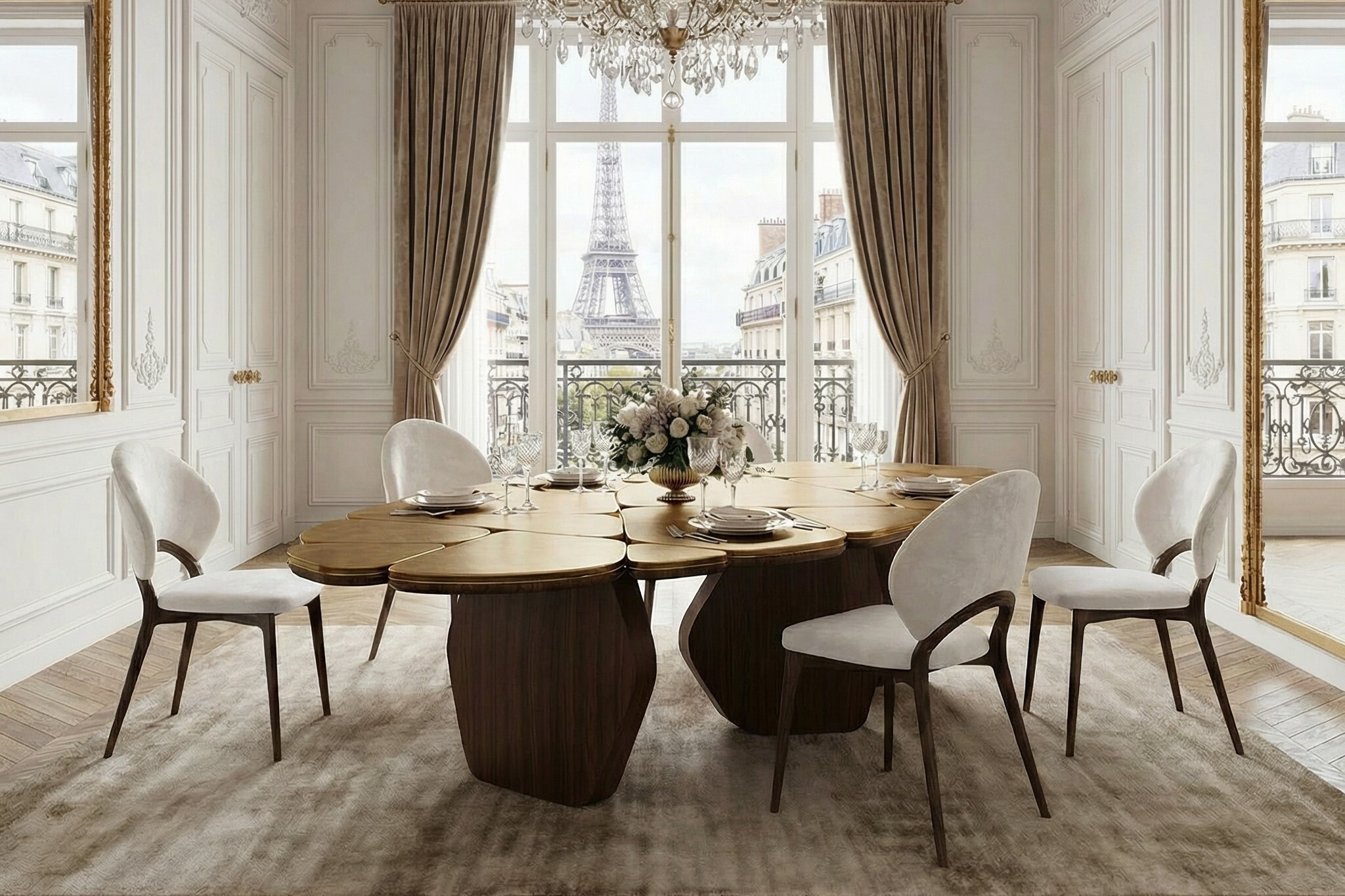
Pieces such as the Darvaza Dining Table or the Hikma bookcase, both drawn from real places and histories rather than abstract shapes, show how a documented, story-based design can scale across a project without losing its identity from phase to phase.
The Real Test Is the Second Phase, Not the First Order
Any supplier can impress with a first delivery. The real test of a premium furniture partner is whether the second phase, ordered a year later, matches the first in finish, tone and proportion, without the architecture firm having to intervene. That consistency is built on documentation, traceable materials and a team that stays reachable past the point of sale. Firms that ask for this evidence early, rather than assuming it, are the ones that avoid unpleasant surprises in year two of a project.